One craftsman, start to finish
No production line and no handover. The person who measures your room cuts the frame, stretches the surface and carries the table through your door.
BBOG is a small guild workshop. We select claro walnut, rift white oak, wenge and olive ash board by board, joint the frames by hand, stretch the playing surface ourselves and finish every table to the dimensions of the room it will live in. Chip sets are drawn to your monogram in the same shop.
Tell us when it suits you to talk through a build. A craftsman — not a call centre — reads every note.
BBOG began in 2005 as a furniture bench that kept being asked for the same odd thing: a proper card table. Not a folding top with a vinyl cover, but a piece of furniture a room could be built around. Two decades later the workshop does nothing else. Every commission is drawn, cut, joined and felted by the same craftsman from first sketch to delivery, and the client speaks to that craftsman throughout.
We are deliberately small. The shop takes a limited number of commissions each season because rare stock cannot be hurried and hand-cut rails cannot be batched. What that buys you is a table with matched grain, honest joinery and a surface that plays the same in year ten as it did on the first night.
No production line and no handover. The person who measures your room cuts the frame, stretches the surface and carries the table through your door.
Boards are bought in the rough, kiln-dried to a stable moisture content and rested in the shop before a saw touches them, so the top stays flat through damp Welsh winters.
Playing cloth is cut, eased and stapled by hand around a padded rail, then trimmed under tension — the reason a card slides true instead of catching a seam.
Trays, card wells and a slide-away tray lid are let into the frame flush with the rail, so the table reads as furniture when the game is over.
We work from your measurements: seat count, walkway clearance, chair height, doorways and stair turns all shape the drawing before any wood is cut.
Cloth wears; the frame should not. Every BBOG table can come back to the bench for a fresh playing surface for as long as the workshop is open.
Most clients arrive with a room and an idea. These are the four routes that idea usually takes through the shop — and what each one is actually for.
A table drawn around your room and your game: oval, octagon, round or a bespoke footprint, in the species you choose, with the seat count, rail height and tray layout specified before the build begins.
The benefit: a piece sized to the space it lives in, so chairs move freely and nobody plays with their back against a wall.
Chip faces and edge patterns drawn to your monogram, club mark or house crest, sampled in a proof set before the full run, and stored in a matching hardwood case built on the same bench.
The benefit: a set that belongs to one room and one group, recognisable at a glance and impossible to mix up with a borrowed set.
Inherited and mid-century tables stripped back, re-glued, re-veneered where the figure survives, re-railed and re-felted, keeping original hardware wherever it can still be trusted.
The benefit: the table stays the one your family already owns, playing properly again rather than being replaced.
Advice on the room itself — table placement and clearances, seating, lighting height and glare, flooring, acoustics and where storage should sit so the room works on a full night.
The benefit: the room is planned once, properly, instead of being rearranged around a table that arrived first.
Each of these began as a room measurement and a stack of rough boards. Filter by what you are planning — on a phone the row scrolls sideways.
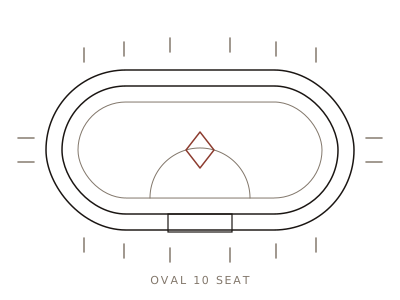
Ten seats in claro walnut with a dealer cut-out, a padded armrest rail and a centre inlay diamond in contrasting heartwood.
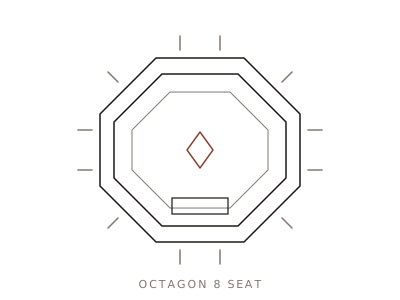
Eight facets in wenge with white oak splines at every corner, built for a club room where the table is used several nights a week.
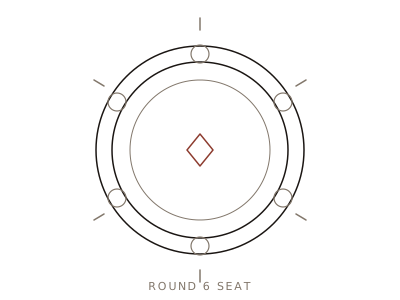
Six seats in rift white oak on a single turned column, with recessed wells and a removable dining top for rooms that do two jobs.
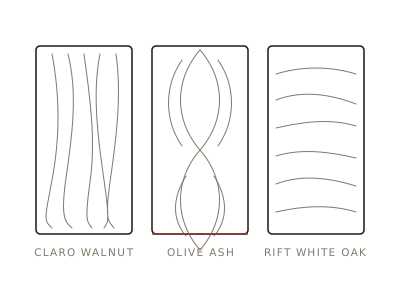
Book-matched leaves laid up in the shop for rail faces and column wraps, so the figure runs continuously around the table instead of stopping at a joint.
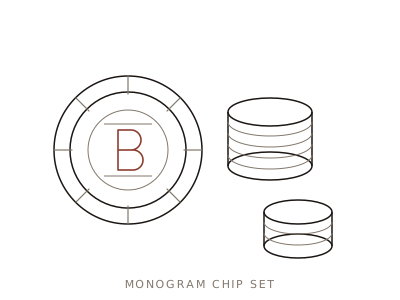
Faces drawn around a client monogram with a repeating edge pattern, proofed as a sample set first and cased in matching hardwood.
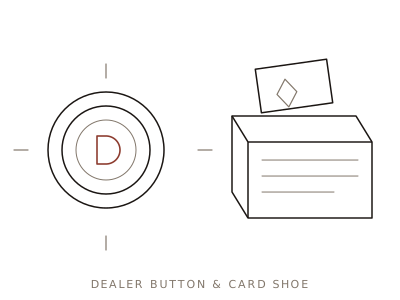
A turned button in the table's own offcut stock and a dovetailed shoe with a brass-pinned lid, so the small pieces match the big one.
Every illustration on this page is a drawing of a build, not a photograph — the workshop publishes measured line art rather than staged imagery.
Nothing is skipped and nothing is improvised on the shop floor. You see the drawing before the saw runs, and you see the wood before it is cut.
We talk through the room, the seat count, how often the table is used and who sits at it. You send measurements and photographs of the space; we send back what will and will not fit.
Species are narrowed to two or three, then actual boards are pulled from the rack and photographed for you. Grain, colour and figure are agreed on the real stock, not from a sample chart.
A dimensioned drawing sets the footprint, rail profile, tray placement, leg or pedestal design and finish. Nothing is cut until you have signed that drawing off.
Frame joinery, veneer lay-up, rail padding, cloth stretching, engraving and hand-rubbed finish, with progress photographs at each milestone so the build is never a black box.
The table is blanket-wrapped, carried in, assembled in place, levelled to your floor and wiped down. We leave with the offcuts and a written care sheet on the rail.
Six decisions shape almost every commission. Open any of them to see how the workshop handles it.
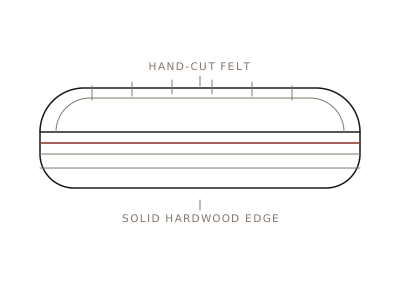
A BBOG rail is a padded arc over a solid hardwood edge — not a foam ring stapled to plywood. The cloth is tensioned across the pad and closed underneath, so the seam never sits where an arm rests.
Species are chosen for how they behave, not only for how they look. Dense tropical stock holds a crisp edge and a dark field; domestic hardwoods take a warmer finish and are easier to re-work years later.
The playing surface is a speed cloth or a traditional woollen baize, laid over a suspended pad. Rails come padded, half-padded or bare hardwood depending on how long the sessions run.
Marks are cut into the wood rather than printed on it. A monogram can sit at the dealer position, on the rail cap, or as a centre medallion in contrasting heartwood.
Every table leaves with a cover cut to its own footprint. Covers matter most in rooms with strong daylight, where an uncovered cloth will fade unevenly around where people sit.
A hand-rubbed finish is repairable, which is the point of it. Looked after simply, a BBOG top will outlast several sets of cloth.
Structural joinery is warranted against failure in normal indoor use. Cloth, foam and hardware are wear items and are covered by the re-felt programme instead.
Clients who come back — and the clubs we build for regularly — are looked after in ways that have nothing to do with paperwork and everything to do with access to the shop.
Returning clients are slotted into the season's schedule ahead of the general list, which matters most when a room has a date it must be ready for.
On a repeat commission, the monogram work — rail cap, tray lid or centre medallion — is included as part of the build rather than treated as an addition.
Two evenings a season the bench opens to existing clients: finishing demonstrations, cloth stretching, and a look at the rare stock that has just come in.
Clubs running several tables get a scheduled care visit, on-site rail touch-ups and a held reserve of their matched cloth so a replacement never has to be approximated.
Introduce another club and both rooms move up the queue together, with a joint consultation so the two builds can share a stock run and a delivery.
BBOG stays small on purpose, but it does not stay closed. If you work with wood, run a private room, or want to learn the trade properly, there is a way in.
Tell us what you are planning and we will tell you honestly whether the shop is the right fit. Email is our only channel — it keeps a written record of every specification.
Sport Casual Limited
7 Grove Park Road
Wrexham, Clwyd, LL12 7AA, United Kingdom
Every field marked with an asterisk is required. Nothing here leaves your browser — see the note under the button.